Crafting Your Game: The Essential Ice Hockey Playbook
For coaches, players, and strategic minds in the fast-paced world of hockey, a well-organized system is as crucial as a sharp skate blade. An Ice Hockey Playbook serves as the foundational blueprint for this system, a dedicated space to diagram plays, document strategies, track player development, and crystallize the philosophy that drives a team’s success. Unlike generic notebooks, a purpose-built playbook transforms chaotic ideas into executable game plans, bridging the gap between coaching theory and on-ice reality.
Many understand the need for such a tool, yet often fall into the trap of using makeshift solutions—scattered notes on loose paper, hastily drawn diagrams on a whiteboard that get erased, or digital files scattered across different apps without a unified format. This ad-hoc approach leads to a significant loss of institutional knowledge. Plays that worked brilliantly in a crucial game are forgotten; subtle adjustments to power-play setups vanish; individual player feedback and progress notes are never consolidated. The result is a repetitive cycle of reinvention and inconsistent communication, ultimately affecting the team’s coherence and development.
Overlooked Details in Selecting Your Playbook Tool
When the decision is made to formalize strategy with an Ice Hockey Playbook, the focus tends to jump immediately to content: “What plays will I put in it?” This is a natural instinct, but skipping the critical evaluation of the tool itself—the physical or digital interior you’ll use to build that content—can undermine the entire project. The container matters as much as what you pour into it.
A common misunderstanding is assuming any template or notebook with hockey imagery is sufficient. The real value lies in the functional layout. Does it have dedicated, clear areas for diagramming the neutral zone forecheck? Are there adjacent note fields to specify player roles and timing cues? Is there a structured section for post-game analysis linked directly to the play used? If not, you’re likely just decorating a generic journal, not employing a specialized tactical instrument.
Practical Pitfalls in Format and Quality
One of the most costly mistakes involves technical specifications, especially for those looking to produce or publish a professional playbook. Consider the scenario of a coach creating a playbook to distribute to their staff or sell to a wider audience. They might design a beautiful set of pages but neglect the crucial production standards required by platforms like Amazon KDP (Kindle Direct Publishing).
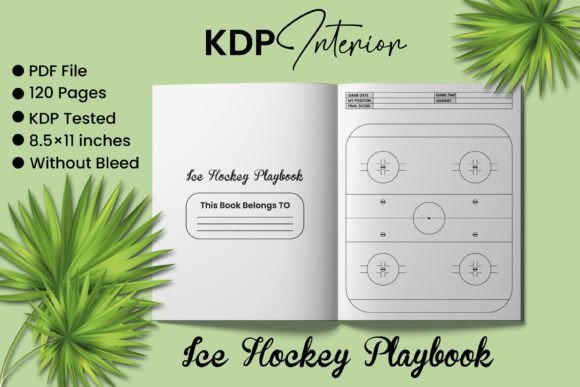
For example, using incorrect dimensions or low-resolution images can lead to a final product that looks pixelated or improperly scaled when printed. A file without a tested, ready-to-upload interior may be rejected by automated checks or result in poor customer reviews. Another overlooked detail is the inclusion of bleed—an area of design that extends beyond the final trim size. For an interior intended as a workbook or printable, having no bleed is often the correct specification, as it ensures all content sits safely within the viewable page after binding. Choosing a template with bleed where it’s not needed, or vice versa, compromises the professional presentation immediately.
The advice here is decidedly practical: before committing to any Ice Hockey Playbook interior, verify its production readiness. A quality offering should explicitly state compatibility, such as being tested on Amazon KDP, and provide clear technical details: 8.5×11 inches, high-resolution 300dpi PDF and JPG files, and a total page count that matches your needs. These aren’t just marketing points; they are indicators that the provider understands the end-use, saving you from the frustration of failed uploads and substandard outputs.
Structuring for Actual Use, Not Just Inspiration
Another subtle error is designing or choosing a playbook that looks impressive in a preview but fails in daily use. Inspiration is fleeting; utility is enduring. A playbook crammed with complex graphics on every page might feel motivating at first glance, but if those graphics consume space needed for handwritten adjustments and notes, the tool becomes obsolete after the first game.
A better approach is to prioritize clarity and flexibility. Sections should be logically ordered—perhaps starting with core system philosophy, moving into breakout and zone-entry plays, then special teams, and finishing with player evaluation templates. Each play diagram page should have ample whitespace around it, inviting annotations, arrows, and “what-if” modifications. This accommodates the dynamic nature of hockey; a play drawn on Tuesday might need three tweaks by Saturday’s game, and the playbook must capture that evolution.
Realistically, a coach might think, “I need 50 play diagrams right away,” and seek a template packed with pre-drawn formations. While this seems efficient, it can lock you into a rigid mindset. Often, it’s more effective to start with a smaller set of blank or semi-structured diagram pages, allowing you to build your systems organically based on your team’s specific strengths and weaknesses. The playbook should facilitate your thinking, not replace it.
Ensuring Accessibility and Long-Term Value
Finally, consider accessibility and preservation. A physical binder is great for the locker room, but what about remote review or sharing with assistant coaches? A digital, printable Ice Hockey Playbook PDF offers a solution, provided the file is genuinely high-resolution and properly compressed for distribution. The convenience of having all files—the interior, cover assets, instructions—compressed into one organized ZIP file is not a minor feature. It speaks to a provider who has considered the user’s entire workflow from download to upload or print.
Before making a decision, ask yourself: Does this tool scale? If my team adds new players next season, can I easily duplicate and update evaluation pages? If I want to sell my compiled strategies, is the interior format professionally polished and platform-ready? Investing in a tool that answers “yes” to these questions avoids the sunk cost of a disposable solution and builds a strategic asset that grows with your coaching career.
The goal is to move from reactive coaching to proactive leadership. An effective Ice Hockey Playbook is the catalyst for that shift. By paying attention to these often-overlooked details—technical specifications, functional layout over mere aesthetics, and long-term adaptability—you select not just a product, but a partner in your team’s development. It turns your insights into a lasting, communicable, and improvable system, putting you, and your players, in control of the game’s narrative.