Isometric Grid Paper: The Secret Tool for Creators, Engineers, and Problem Solvers
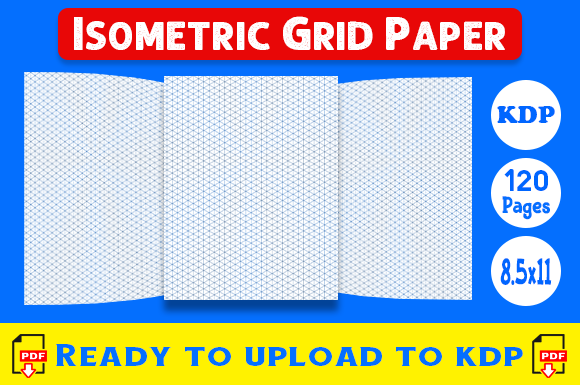
If you’ve ever sketched a three-dimensional object on regular paper and struggled to make it look “right,” you’ve experienced the limitation of a blank page. Isometric grid paper solves that problem intuitively. It’s a specialized paper featuring a grid of equilateral triangles, creating a uniform network of dots or lines at 60-degree angles. This simple geometric structure provides a ready-made framework for drawing objects in a consistent three-dimensional perspective, without the need for complex perspective calculations.
Unlike traditional square grids that force you into a flat, top-down view, isometric grid paper lets you build shapes that appear solid and dimensional from a fixed viewpoint. It’s the bridge between a freehand sketch and a technical drawing, offering guidance without rigidity. For anyone who needs to visualize space, structure, or design in 3D, this tool turns a complex task into a straightforward process.
Where and Why This Unassuming Paper Becomes Essential
You might think isometric grid paper is a niche tool for engineers, but its applications are surprisingly broad. It’s used whenever thinking in three dimensions is more helpful than thinking in two. Let’s look at some real situations.
Imagine a hobbyist woodworker planning a new bookshelf. On regular paper, they might draw the front view, the side view, and the top view separately. On isometric grid paper, they can draw the entire bookshelf as a single, cohesive 3D object. They can see how the joints relate, visualize the proportions accurately, and spot potential design flaws before cutting any wood. The grid ensures all angles are consistent, so the sketch is both a creative exploration and a practical blueprint.
In the world of game design and pixel art, isometric grids are foundational. Creating assets for isometric video games—where the world is viewed from this specific angled perspective—requires precise alignment. Artists use the grid to build towns, characters, and items that fit perfectly into the game’s engine. A downloadable, high-resolution PDF interior with a clean isometric grid, like one ready for KDP, becomes a digital canvas for crafting these detailed environments.
From Classroom Concepts to Business Prototypes
Educators, particularly in STEM fields, find isometric grid paper invaluable for teaching spatial reasoning. A student learning geometry or engineering principles can draw crystalline structures, mechanical parts, or architectural forms in a way that reveals their true spatial relationships. It transforms abstract concepts into tangible diagrams. The act of drawing on the grid reinforces understanding far more effectively than just viewing a prepared image.
Freelancers and small business owners often use it for rapid prototyping and client communication. A graphic designer might use it to sketch a 3D logo concept. A marketer could draft the layout for a trade show booth display. Presenting a client with a clear 3D sketch on isometric grid paper is more impactful than a vague description; it grounds the idea in a visual reality, facilitating better feedback and faster decision-making.
Even in everyday life, it has utility. Planning the layout of a garden, arranging furniture in a room, or sketching a DIY project for your home—these are all tasks involving volume and space. An isometric sketch helps you play with arrangements and anticipate how elements will coexist in the actual space, preventing costly or frustrating mistakes.
Considering Your Needs Before You Download or Print
Not all isometric grid paper is the same, and your intended use dictates what you should look for. The first consideration is grid density. A finer grid, with more dots or lines per inch, is excellent for detailed, technical drawings like engineering components or intricate game art. A broader grid is better for quick sketches, brainstorming, or educational purposes where precision is less critical than the overall concept.
The format matters immensely. If you’re working digitally, a high-resolution PDF is key. A low-resolution file will produce blurry lines when printed, making the grid difficult to use accurately. For a product intended for KDP (Kindle Direct Publishing) or professional print, such as an interior file tested for that platform, the assurance of high-resolution means your end-users—whether you’re selling it or using it yourself—get a crisp, reliable tool. A trim size of 8.5×11 inches is the standard US letter format, compatible with most home printers and professional printing services, making it universally practical.
Think about your workflow. Do you need to print multiple copies for a classroom or team? Do you plan to use it in a digital app, tracing over the grid on a tablet? A ready-to-use PDF file offers flexibility: print it when you need physical paper, or use it as a background layer in your favorite digital drawing software. The instant download aspect is about removing friction; you identify the need and have the tool in your hands moments later, without waiting for a physical shipment.
The Tangible Benefits Across Different User Stories
For the entrepreneur publishing niche printables on KDP, a well-designed isometric grid paper interior is a product that solves a specific problem for a specific audience. Its value isn’t in being “pretty” but in being functional. By providing a tested, print-ready file, they’re offering reliability—the customer won’t encounter printing glitches or misaligned margins that render the grid useless. This builds trust and satisfies a real need in the creative marketplace.
For the hobbyist or professional user downloading such a file, the benefit is time and confidence. You don’t have to hunt for a suitable grid online, tweak its size, or worry about print quality. You get a standardized, professional-grade tool immediately. This lets you jump straight into the productive phase: sketching, planning, and creating. The grid becomes a silent partner in your process, ensuring your visual ideas are built on a solid, consistent foundation.
Ultimately, isometric grid paper is more than just paper. It’s a thinking aid. It externalizes the challenge of three-dimensional visualization and provides a structured path to a solution. Whether you’re designing a product, teaching a student, planning a space, or creating digital art, it takes the cognitive load off your shoulders and lets you focus on the creative or technical problem itself. In a world where we often jump straight to complex 3D software, this analog (or digital-analog) tool reminds us that clarity often begins with a simple, well-guided sketch.