The Clue Score Sheet Book: A Practical Tool for Structured Analysis and Decision-Making
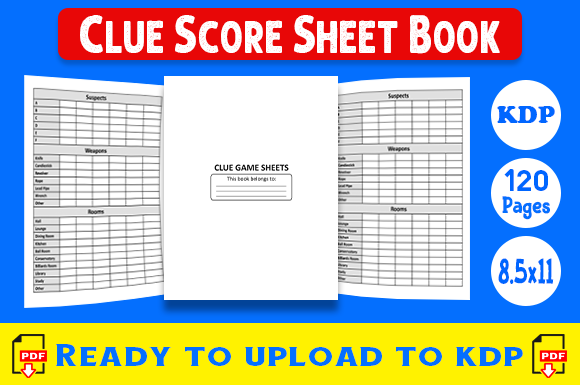
In the midst of managing projects, evaluating options, or navigating complex tasks, a common challenge arises: how to systematically track, weigh, and compare disparate pieces of information. Whether you're brainstorming a marketing campaign, planning a home renovation, researching a major purchase, or simply trying to organize your thoughts on a personal goal, the need for a clear, consistent framework is universal. The Clue Score Sheet Book addresses this need directly. It is a ready-to-use interior PDF designed as a structured notebook for scoring, ranking, and analyzing clues, factors, or criteria.
Fitting the Clue Score Sheet Book into Your Workflow
The core value of the Clue Score Sheet Book lies in its integration into broader processes. It is not a standalone solution but a focused tool that enhances existing methods of analysis. Think of it as the specialized worksheet you bring out when a task requires more than simple note-taking. Its trim size of 8.5x11 inches and high-resolution design ensure it is practical for both digital use and physical printing, fitting seamlessly alongside other planners, project documents, or research materials.
Consider a typical workflow for a professional evaluating software platforms for their team. The process might involve gathering vendor information (clues), listing required features (criteria), and comparing costs and support (factors). Without a structured sheet, this data often ends up scattered across emails, sticky notes, and disparate documents, making objective comparison difficult. The Clue Score Sheet Book provides a dedicated space to centralize this evaluation. Each clue or criterion can be entered, scored, and annotated, transforming subjective impressions into a quantifiable, reviewable record.
Key Stages for Implementation
The utility of the book spans three key stages: preparation, active analysis, and review.
During Preparation: It serves as a planning canvas. Before diving into research or a creative process, you can use the sheets to outline the key areas you need to investigate. Defining your scoring categories upfront—whether it’s “usability,” “cost-effectiveness,” or “creative alignment”—forces clarity of thought and sets the direction for your subsequent work.
During Active Analysis: This is the book's primary moment of use. As you gather information, you populate the sheets. The act of assigning a score or ranking to each clue creates a pause for critical thinking. It interrupts the flow of passive information consumption and requires you to judge its value. For a blogger comparing topics for a new series, or an entrepreneur assessing potential business partnerships, this active scoring fosters discipline and reduces bias.
During Review and Decision: After the analysis phase, the completed sheets become a consolidated reference. You can quickly see which options scored highest, identify patterns in the data, and justify your final decision based on the recorded evidence. This is invaluable for quality control and consistency, especially in team environments where decisions need to be transparent and defensible.
Interacting with Other Tools and Methods
A practical tool must coexist with the ecosystem you already use. The Clue Score Sheet Book interacts complementarily with several common resources.
For users of digital project management platforms like Asana or Trello, the sheets can act as a deep-dive supplement. While the platform tracks tasks and deadlines, the score sheet provides the detailed analysis behind a specific decision logged within a task. Similarly, for those who rely on mind-mapping software for brainstorming, the score sheets offer a next logical step: taking the divergent ideas from the map and evaluating them against set criteria to converge on the best paths.
In creative fields, it interacts with mood boards, sketchbooks, or manuscript drafts. A designer might use clues (client feedback, style references, technical constraints) to score different design directions. An author could use it to evaluate plot developments or character arcs against thematic goals. The book brings a layer of analytical rigor to the creative process without stifling the initial generative phase.
For educators and trainers, it can be integrated into lesson planning or curriculum development, scoring different educational activities against learning objectives and student engagement factors. For freelancers and small business owners, it pairs well with financial spreadsheets; the spreadsheet handles the numbers, while the score sheet handles the qualitative pros and cons of a new investment or service offering.
Practical Tips for Integration and Use
To integrate the Clue Score Sheet Book smoothly, start by identifying a single, upcoming decision or analysis point in your routine. Don’t attempt to overhaul all processes at once. Select one—perhaps a vendor selection, a content topic choice, or a personal goal like choosing a learning course.
Customize the sheets for your purpose. The generic template is a starting point. Write your specific categories at the top. You might have columns for “Evidence Strength,” “Resource Cost,” “Alignment with Goal,” or “Feasibility.” The flexibility is key. Use one sheet per option you're evaluating, or use one sheet to list all clues related to a single criterion.
Establish a simple scoring system. It could be a 1-5 scale, a high/medium/low ranking, or even a simple checkmark system for meeting requirements. Consistency in how you apply scores across all entries is more important than the complexity of the system itself.
Keep the book accessible. Since it’s provided as a tested PDF ready for upload to KDP, you can have it printed as a physical notebook for tactile work, or keep it as a digital file to fill out on a tablet or computer during research sessions. Its high-resolution ensures notes written in print or typed digitally will remain clear and legible for long-term reference.
Enhancing Organization, Efficiency, and Long-Term Value
The organizational benefit of the Clue Score Sheet Book is direct. It prevents analysis from becoming a chaotic, forgotten pile of notes. By consolidating thoughts into a formatted space, it creates a reliable archive. This is crucial for long-term projects or recurring decisions. For instance, a marketer who evaluates campaign performance quarterly can use past score sheets to track how their assessment criteria and the performance of different tactics have evolved over time.
Efficiency gains come from reducing repetitive thinking. Once you’ve established your scoring framework for a type of decision, you can reuse it. If you frequently evaluate similar things—like potential blog topics or new software tools—you can develop a standardized set of criteria in your Clue Score Sheet Book. This turns a new analysis from a blank-slate chore into a faster, templated process.
Usability is baked into its design. The tested 8.5x11 format is a standard, comfortable size for both binding and reading. The single PDF file structure means no complex setup or software dependency; it’s instantly downloadable and ready for use. This low-friction access encourages actual use rather than abandonment.
For quality control, especially in collaborative settings, the book provides a shared document of reasoning. Team members can all contribute clues and scores, creating a transparent audit trail for why a particular direction was chosen. This mitigates “decision amnesia” and helps align teams around objective data rather than subjective opinion.
Real-World Application Examples
To move from concept to concrete application, consider these scenarios.
A product manager scoping a new feature uses the sheet to score user feedback clues (from support tickets and forum posts) against development cost and strategic value. Each piece of feedback becomes a clue with a score for “urgency” and “impact,” leading to a prioritized feature list.
A hobbyist planning a complex model-building project uses it to evaluate different construction techniques or material choices. Clues from tutorial videos, forum advice, and personal experience are scored on “difficulty,” “finish quality,” and “cost,” guiding the most effective approach.
An educator designing a new workshop scores potential activities against “student engagement,” “learning outcome match,” and “preparation time.” This ensures the final lesson plan is balanced and effective.
A freelancer deciding on a new service to offer analyzes market demand clues, required skill investment, and potential profitability. The scored analysis provides confidence that the new direction is data-informed, not just a gut feeling.
In each case, the Clue Score Sheet Book acts as the analytical engine within a larger workflow of information gathering, deliberation, and action. It brings order to the middle phase—the often messy phase of synthesis—where most indecision and inefficiency occurs.
Making it a Sustainable Part of Your Process
The key to long-term use is linking it to outcomes. After you complete a set of sheets and make a decision, take a moment to reflect. Did the scoring highlight something you would have otherwise missed? Did it make the final choice easier to explain? This reinforcement of value builds the habit.
Store your completed books methodically. Whether as a printed binder or a folder of PDFs, treat them as part of your project archives or decision logs. Over time, they become a valuable repository of your past thinking patterns, useful for refining your future criteria and avoiding previous pitfalls.
Ultimately, the Clue Score Sheet Book is a pragmatic answer to a common need: the need for a clear space to think through choices. It fits into the gaps between your other tools, providing a simple, consistent, and reusable format for turning information into insight. By dedicating a physical or digital space to this analytical work, you elevate it from a hidden mental process to a tangible, improvable part of your workflow, leading to more structured, confident, and effective outcomes in both professional and personal endeavors.