Understanding the Role of a Delivery Driver Log Book
In the world of courier services, food delivery, and freight transportation, organization is not just a preference; it is a necessity for operational efficiency and financial accuracy. A Delivery Driver Log Book serves as a dedicated physical record for drivers to systematically document their daily professional activities.
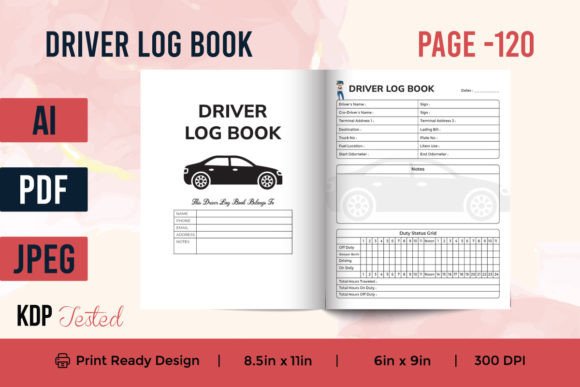
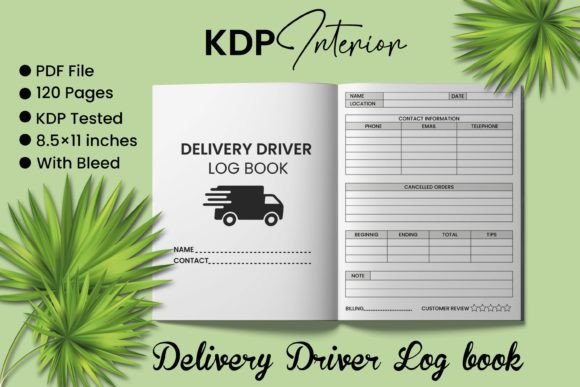
Typically structured like a journal or ledger, a Delivery Driver Log Book provides pre-formatted pages for entries such as date, start and end times, vehicle information, delivery addresses, miles driven, fuel usage, expenses incurred, and notes on special instructions or incidents. Its core function is to transform disparate daily data into a coherent, chronological record.
Primary Reasons for Interest in a Log Book
Individuals and businesses consider using a Delivery Driver Log Book for several concrete reasons. Independent contractors, such as those working for gig economy platforms, often lack provided tools for detailed record-keeping. A personal log book empowers them to capture data independently of any app or company system.
For small fleet owners or managers, a standardized log book used by all drivers ensures consistency in data collection, which is vital for internal auditing and performance reviews. Furthermore, anyone concerned with tax preparation finds a log book indispensable. Detailed logs of business miles and expenses are required for accurate deduction claims with tax authorities, and a well-maintained book provides robust evidence in case of queries.
Evaluating the Benefits and Practical Trade-offs
The primary benefit of a Delivery Driver Log Book is the consolidation of critical information. Having a single, physical reference point for all daily metrics reduces the risk of losing receipts or forgetting details. It promotes discipline, encouraging drivers to record information at the moment it happens, leading to greater accuracy.
From a financial perspective, it directly supports income optimization. By meticulously tracking deductible expenses and miles, drivers can lower their taxable income, potentially leading to significant savings. For businesses, it enhances operational transparency, making it easier to analyze routes, calculate per-delivery costs, and identify areas for efficiency improvement.
However, adopting a physical log book involves certain trade-offs. The most evident is the requirement of manual entry. This process demands time and commitment at the end of each shift or throughout the day, which some may find cumbersome compared to digital solutions that automate some data capture. Physical books can also be susceptible to damage, loss, or misplacement, unlike cloud-based digital records that can be backed up.
Another consideration is the inherent limitations of a static format. A pre-designed book may not have fields for every unique variable a specific driver needs to track, whereas a custom digital spreadsheet can be infinitely tailored. Users must assess whether the standard categories in a typical log book align with their specific reporting needs.
Situations Where a Delivery Driver Log Book Is a Strong Fit
A physical Delivery Driver Log Book is particularly well-suited for certain scenarios. For drivers who prefer analog tools or have limited access to reliable technology during their routes, a paper book is practical and failsafe. It does not require battery power, internet connectivity, or software knowledge.
Individuals who value a tangible, handwritten record for its legal or psychological weight often find a book more authoritative. The act of writing can reinforce memory and accountability. Furthermore, for those managing multiple drivers, providing identical physical log books ensures uniform data collection without needing to train personnel on diverse software applications, simplifying the managerial review process.
It is also a strong fit for anyone prioritizing a straightforward start to organized record-keeping. Downloading and printing a ready-made KDP interior, for instance, offers immediate structure without the upfront time investment of designing a custom digital template.
Considering Alternatives and Complementary Tools
While a physical Delivery Driver Log Book offers many advantages, alternatives exist and may be worth considering depending on a user's specific workflow. Dedicated mileage tracking apps and expense management software offer automation, such as GPS-based mile logging and photo capture for receipts. These can drastically reduce manual input time and provide sophisticated reporting features.
A simple digital alternative is a spreadsheet template on a mobile device or computer. This offers customization and easy duplication or sharing of files. For drivers already deeply integrated into a specific delivery platform's ecosystem, the company's own in-app tracking features might provide sufficient basic data for their purposes, though these are often not as detailed or customizable as a standalone log.
The decision is not necessarily binary. Many drivers successfully use a hybrid approach. They might use a physical Delivery Driver Log Book for quick, on-the-go notes and vehicle checks, then transfer summarized data to a digital system weekly for analysis and tax preparation. This combines the reliability of paper with the computational power of digital tools.
Practical Decision-Making Insights
To determine if a Delivery Driver Log Book aligns with your goals, begin by clarifying your primary need. Is it for irrefutable tax documentation, internal business auditing, or simple daily personal reference? Next, audit your current routine. Do you have five minutes at day's end to write entries? If not, a manual system may not sustain. Consider your environment: if your work involves rain, dirt, or constant movement, a rugged, physical book you can wipe down might be more durable than a smartphone.
Evaluate the cost versus time equation. A ready-to-use log book represents a low initial financial investment but requires ongoing time to maintain. Digital tools may have higher upfront costs or subscription fees but save time in data entry and calculation. Finally, think about scalability. If you plan to grow from a single driver to a small team, the replicability of a physical book—simply purchasing additional copies—is straightforward.
The choice ultimately hinges on personal workflow, trust in technology, and the specific requirements of your accounting or management practices. A well-designed Delivery Driver Log Book provides a structured, disciplined foundation for professional driving records, a tool whose value is proven through consistent use rather than technological sophistication.